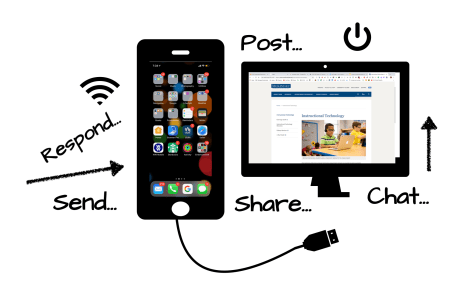
Designing clear communication that can be quickly accessed and processed by any user of technology is important as digital tools change and access changes daily in exponential numbers. Keeping in mind that communication should be streamlined and updated constantly means that I need to ensure that my message and voice don’t get muddled by the platform. Transparency for a message to all stakeholders (students, teachers and parents) will ensure that my philosophy of student empowerment with technology is a standard. I believe that it is important to clearly communicate a direction. If I don’t tell my story, someone else will.

Twitter-
Using social media as a voice for communication has been a “go-to” for me for a while. My blog post about using Twitter as a PLC tool outlines the benefits of micro-blogging and real-time access to ed-tech influencers in the field. There is much to gain from leveraging Twitter as a tool for professional learning and communication, but it can also be used to connect learners with the world beyond the four walls of the classroom at any level. I created and published an iBook to the iBook store titled, The Twitterverse to support the use of Twitter as a tool for teaching, learning and communicating. I have a feed of my own Twitter account on my “about me” page for this portfolio.
Follow me @laralindsey
YouTube-
YouTube is listed as the #2 search engine in the world (second to Google). As it is a mainstream access point for information, it is a great place for housing video communication and information. Creating my own YouTube channel was a new way to organize and connect others to my work and my message. Creating one place for all of my video streamlined communication in an easy to access platform. I blogged about YouTube and its affordances for classroom instruction and communication.
Meet The Parents
In an effort to support parents with technology resources and raising kids in a “selfie-world” our department shared a monthly newsletter spotlighting digital resources, apps, movies and the happenings with classroom technology in the district. Our hope was to create a partnership with parents as we all work together to support learners in a new world of learning. We kicked off our parent series with this presentation to inform our parent stakeholders of our direction. Our digital newsletters were created in Smore and provided us with lots of tools for tracking influence. The back-end analytics played a part in how we continue to communicate our vision to our parent community. We discovered along the way that our parents were much more comfortable and supportive of new technology changes when they felt empowered by information. We presented our strategic communication plan with parents at both TCEA and ACSD conferences: Meet The Parents; The Powerful Capacity of Partnering with Parents & Technology
Telling Our Story…Hearing our Voice
I was able to leverage digital storytelling as a tool for sharing our implementation of a circulating library and maker space at our disciplinary alternative campus. The story was used as a communication tool for our board and later as a way to support several grants for our most at-risk students placed on this campus due to behavior issues. Using the tools and rubric from my digital storytelling class I was able to create a meaningful story that surpassed a traditional multi-media presentation. This story detailed an initiative that might not have been easy to tell without the affordances of iMovie and the narration and music.

My department implemented a high school 1:1 initiative for our district. Using an early adopter model we deployed laptop computers to incoming freshmen students each year until we met 100 percent capacity over 4 years. The initiative is now a district standard for high school students. Although it is the new standard after 6 years of implementation, we know that communication with stakeholders is always important. We maintain a website with information on the why and how of the plan and an updated handbook with FAQs and necessary paperwork. Our direction is maintained on the main MISD website as well. Ensuring parents are heard and informed supports my continuing philosophy of empowering students with technology for tools for learning as well as a continuing partnership with parents.
As a response to the COVID-19 pandemic and the need for 1:1 access for all students, my team expanded our previous high school model to support all PK-12 learners in the district thus ensuring no child was without access to high quality tools for home learning. We rolled out a multi-platform model supporting our PK-1 students with their own iPad while students in grades 2-12 were afforded a dedicated laptop computer. Upon our return to face-to-face learning, these tools continued to play an integral part of lesson design for learning inside and outside the four walls of classrooms. Our team was tasked with turning this massive logistics switch and the necessary training for all stakeholders within a 6-week window of time in order to ensure high quality, anywhere/anytime instruction.
 Lara Lindsey